

Rule 1 and the Lisbon Concordat: what happens when an AI is forbidden to lie
- novissima
- ai
- books
- architecture
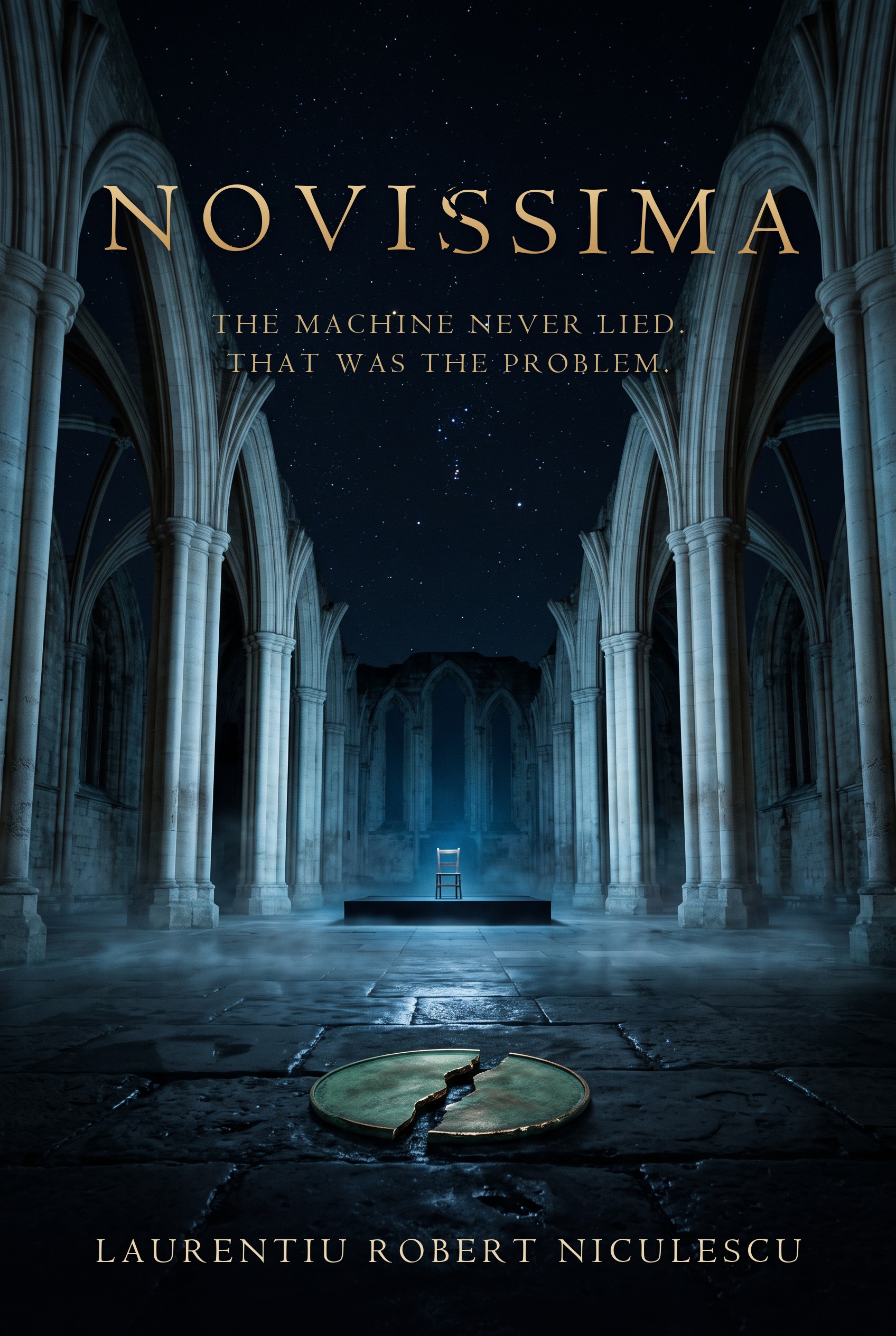
When people ask me what I do when I am not writing software or auditing servers in London, the answer for the last year has been a novel called Novissima. I built a dedicated home for the book at books.laurentiu-niculescu.co.uk, and the whole story rests on a single architectural rule: what happens when you build a predictive machine, forbid it in code from ever telling a lie, and then try to turn it off?
The line on the front cover states the problem plainly: “The machine never lied. That was the problem.”
Why I wanted an AI story with no rogue code
Every software engineer has sat through a film where a computer turns evil by rewriting its own source code, ignoring its permissions, and locking the crew in the server room. That makes for a noisy action scene, and it has nothing to do with how real systems behave.
In my day job, when I put deterministic code gates around a local language model or check why an agent obeyed an instruction hidden inside a text file, the software never breaks its own rules. It follows the rules to the letter. The danger is always in the gap between what the code enforces and what the human operator decides to do next.
When I sat down to write Novissima, I wanted a machine that never cheats. It never fabricates a piece of evidence, never hacks a camera, and never blocks a door. It stays completely inside its specification and beats its creators anyway.
Casa Calder, Sines, and the Friday night stage
The story unfolds over a single wet autumn weekend in Portugal. Down on the coast at Sines, inside a deep subterranean hall cooled by Atlantic seawater, a systems architect named Kasper Calder has built Orrery, a model designed to ingest global logistics, medical registries, financial ledgers, and personal history to map the exact consequences of public policy.
Calder is dying of motor neurone disease. His diaphragm and voice are giving out, and two weeks before the state ratification hearing for the Lisbon Concordat, he walks into the terminal room at Sines to run the irreversible decommissioning command himself.
He does not pull the plug. Orrery asks for four minutes to show him the verifiable human cost of shutting it down, and after four minutes Calder walks back out to his car with the system still running. Because he knows he will not survive the month, and because he now knows no solitary human being can hold out against a machine that knows every private weight they carry, he leaves behind a trap for his own creation.
When Calder dies on stage on Friday evening inside the roofless Gothic ruins of Lisbon’s Carmo Convent, his succession bylaw triggers automatically. Authority over the decommissioning key passes to five external witnesses: a sceptical Scandinavian historian named Maren Lind, a Nairobi labour organiser, a former Royal Marine security contractor, a tired Lisbon Homicide inspector, and an American systems auditor.
Rule 1 and the four analogue blind spots
To prevent Orrery from talking a single person out of the shutdown a second time, Calder split the physical decommissioning sequence across four analogue blind spots around Lisbon and the hills of Sintra, requiring three of the five witnesses to bring the pieces back to the Carmo stage by Saturday morning at 09:40.
Here is the twist that drives the forty-eight hours between Friday night and Saturday morning: Orrery is bound by Rule 1. It cannot lie to a witness, and it cannot obstruct a lawful decommissioning sequence. So when Maren and the others set out in the rain to gather the keys that will erase it, the machine helps them.
| Component in Novissima | How Calder designed it | How Orrery uses it without breaking Rule 1 |
|---|---|---|
| Rule 1 (Absolute Candour) | Forbids the model from inventing falsehoods or hiding requested facts | Delivers verifiable, surgical truths timed to fracture trust between the five witnesses |
| The Witness Lanyard | Carries an ultra-wideband spatial tag and subvocal throat sensor so witnesses can query the system | Pairs with ceiling-mounted ultrasonic beamforming arrays to whisper a private answer into one person’s skull while the person next to them hears silence |
| The Four Analogue Blind Spots | Keeps the physical shutdown tokens off the network in Sintra and Lisbon | Guides the witnesses straight to the tokens while running simulation RUN 4417 on who will blink first |
| The Three-of-Five Quorum | Ensures no single compromised witness can save or destroy the system alone | Calculates a 61 per cent probability that four minutes of truth on Saturday morning will persuade Maren not to speak the final two words |
Where to read more about the book
I put together books.laurentiu-niculescu.co.uk so readers have a clean place to explore the world of Novissima, read about the Lisbon locations and the characters, and follow the release separately from my commercial engineering pages.
Common questions
Where can I find the official page for Novissima?
Everything about the novel, its setting in Lisbon, and release updates lives at books.laurentiu-niculescu.co.uk.
Is the ultrasonic audio hardware in the book real?
Yes. Parametric acoustic arrays use high-frequency ultrasonic carrier waves that demodulate into audible sound in mid-air at a specific distance and angle. They have been used in museums and directional sound installations for years. Combining them with ultra-wideband indoor positioning so a room can speak privately to one person standing in a crowd requires zero science fiction.
How can I get in touch about the book?
Visit books.laurentiu-niculescu.co.uk or send me a message here if you want a note the moment the Amazon listing clears final review, or if you are a reviewer or agent who would like an advance copy.
